

The latest from Marvin
Biofuels on the Rise: How Expanding Certifications Are Making Traceability a Strategic Imperative
As bioenergy markets expand and certification frameworks like ISCC, 2BSvs, RSB and RenovaBio tighten requirements, unified traceability is becoming critical for market access.
Introduction
The global bioenergy market has experienced strong growth in recent years, with the market size estimated to have increased from USD 296.09 billion in 2024 to USD 323.44 billion in 2025, representing a compound annual growth rate (CAGR) of 9.2%. This growth has drawn increased attention to the sector. In addition, new sustainability and traceability standards are contributing to intensified regulatory scrutiny and expanding compliance requirements.
Teams responsible for certification, compliance, and sustainability frequently face fragmented supplier data, overlapping certification requirements, and reactive audit cycles that require significant internal resources, specialized expertise, and increase the risk of non-compliance.
As Talita Asano, Customer Success and Certifications Specialist at Marvin, notes:
“Market access now depends on verifiable performance and following global standards. Certification isn’t just about meeting regulations, it’s how you get into high-value export markets.”
The Global Bioenergy Sector
Bioenergy has become a key part of the global shift to renewable energy. In 2025, it provided about 9% of the world’s total energy, growing steadily in power, heat, and transport fuels (World Bioenergy Association, 2025). Policy incentives, corporate demand for low-carbon options, and international decarbonization commitments are driving that growth.
In addition to electric vehicles and decarbonized power, new categories of low-carbon transportation fuels are accelerating this trend. Sustainable aviation fuel (SAF) and sustainable maritime fuels (SMF) are designed to reduce emissions in sectors where electrification is not yet viable, such as long-haul aviation and ocean shipping. Although SAF still represents a small share of global jet fuel consumption, binding mandates in Europe and expanding incentive structures globally are pushing for increasing adoption. Similar pressure is emerging in maritime transport as regulators and cargo owners demand lower-carbon alternatives to conventional bunker fuels. In the United States, the Clean Fuel Production Credit under Section 45Z of the federal tax code links tax incentives directly to lifecycle carbon intensity, reinforcing the financial value of verifiable emissions reductions.
These new fuel categories do more than create demand, they also raise the bar for documentation. Producers must now demonstrate not only carbon performance, but also full traceability of feedstock origin, land-use compliance, and chain-of-custody integrity across markets.
In Europe, regulatory frameworks are shaping how these requirements are enforced. The European Union’s Renewable Energy Directives (RED) establish binding sustainability rules and greenhouse gas limits for bioenergy, implemented through recognized certification systems.
While the RED directives originate in the EU, and the Section 45Z tax incentives operate in the U.S., their combined influence extends far beyond their regions, shaping how bioenergy is produced, certified, and traded in global markets.
Within this global context, Brazil’s biofuel sector represents a critical node in international trade and sustainability compliance. The national RenovaBio program certifies more than 90% of ethanol production and has helped avoid over 147 million tonnes of CO₂ emissions since it began. The program also ensures domestic production meets international sustainability standards (Agência Nacional do Petróleo, 2025).
With so many rules and changes in the market, producers need to stay on top of things. Four certification schemes have become especially relevant for Brazilian producers. To navigate these rules, Brazilian producers rely on four main certification schemes within the European RED framework:
Key Certification Frameworks: Scope and Convergence
- ISCC (International Sustainability and Carbon Certification)
Provides a global standard for agricultural biomass, waste, residues, and bio-based materials. It’s mainly used by producers and exporters who supply biofuels to European markets, ensuring sustainability and carbon reductions are verified across the entire supply chain.(ISCC, 2025).
- 2BSvs
This scheme focuses on traceability and supply-chain transparency. It’s recognized by the European Commission and targets companies that need to demonstrate compliance with EU sustainability rules, especially for biofuels entering RED-regulated markets. (2BSvs, 2025).
- RSB (Roundtable on Sustainable Biomaterials)
Goes beyond regulatory compliance, adding social and governance requirements such as labor standards, human rights, and community engagement. It’s suited for producers and organizations that want to show broader ESG performance alongside carbon and sustainability metrics (RSB, 2025).
- RenovaBio (Brazil)
Brazil’s national certification framework. It links verified GHG reductions to tradable CBIO credits and mainly applies to domestic ethanol producers. For companies exporting to Europe, it also helps meet RED-aligned requirements because its GHG accounting and audits increasingly match European expectations (ANP, 2025).
Talita Asano emphasizes:
“Navigating multiple schemes can be overwhelming, but it’s essential for market access. Understanding each certification’s requirements, and, more importantly, their interrelationships, ensures compliance and preserves the integrity of the supply chain.”
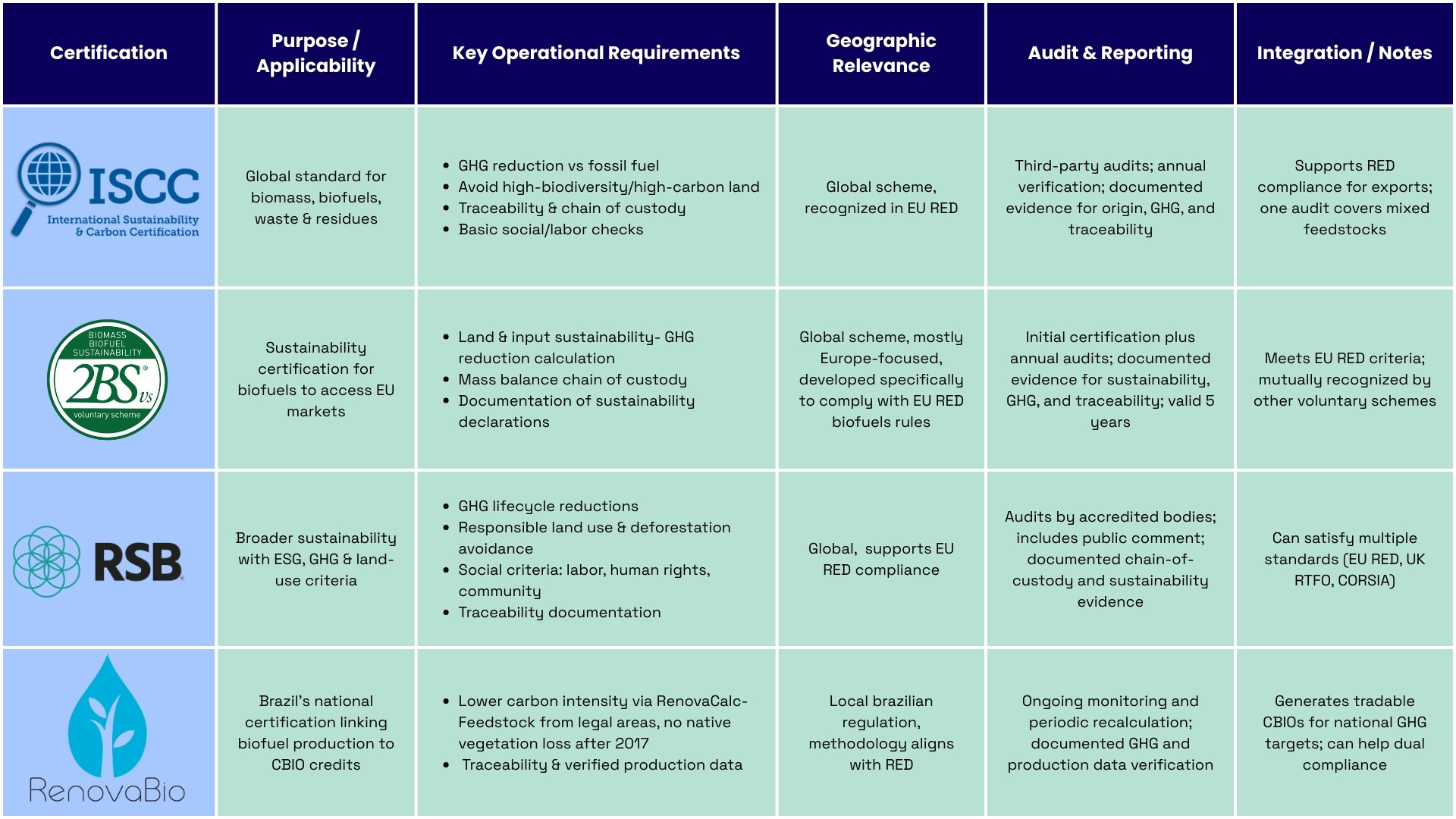
Despite differences in scope and geography, all four frameworks share core requirements: verified GHG reductions, documented feedstock origin, auditable chain-of-custody systems, and traceability from source to end-user. The challenge comes when producers must follow multiple schemes at once, each with slightly different paperwork, audits, and reporting formats.
Below we prepared a comparative table with the requirements for each regulation:
Traceability: From Compliance Checkbox to Structural Backbone
As seen, traceability is a must for the entire certification system. RED requires operators to show that biomass feedstocks meet land-use and sustainability criteria, and that GHG savings actually exceed mandated thresholds. That means keeping a verifiable chain-of-custody linking suppliers, processors, traders, and end users.
In practice, traceability needs a centralized, auditable system that collects supplier declarations, transaction logs, certification statuses, emission factors, and supporting evidence. Without this, companies end up reconciling the same data multiple times, facing more audit findings, or risking disqualification from incentive programs. Even small inconsistencies across a multi-tier supply chain can affect entire batches, creating financial and reputational risk.
Technology Enabling Continuous Compliance Through Unified Data Architecture
Marvin brings certification rules, supplier information, and audit requirements into a single, auditable system. This reduces manual work and lets companies maintain ongoing compliance. By combining multiple frameworks; ISCC, 2BSvs, RSB, and RenovaBio, teams can handle overlapping obligations without slowing down operations.
As Talita Asano, Customer Success at Marvin, explains:
“By automating origin checks, harmonizing data, and preserving primary evidence, we created a single source of truth for certification data. It protects payments, reputation, and business continuity while supporting sustainable growth.”
The results are concrete. Companies like Celena Alimentos, a Brazilian specialty grains producer, have strengthened market credibility and international confidence by using Marvin to streamline certification management, stay audit-ready, and ensure traceable, verifiable GHG reporting across complex supply chains.
Organizations managing multiple certifications can reduce risk and maintain audit readiness by centralizing data and streamlining compliance processes. Marvin provides a single source of truth for certification information, helping teams track traceability, cut down on manual work, and keep supply chains fully verifiable.

Our Latest Resources

In food processing, raw material integrity is the foundation of brand trust. SL Alimentos, a Brazilian processor of oats, grains, and agricultural ingredients, needed an integrated supply chain intelligence system to meet strict global sustainability standards across its supplier base.
Throughout history, civilizational breakthroughs have coincided with shifts in how humanity indexes space, maps energy, and moves physical resources. As Fernand Braudel observed in The Mediterranean and the Mediterranean World in the Age of Philip II, geography remains the unyielding backdrop against which all human enterprise must measure itself.