

The latest from Marvin
Navigating the EU’s PPWR: A Strategic Imperative for Packaging Supply Chains
The EU Packaging and Packaging Waste Regulation (PPWR), requires companies selling packaged goods in the EU to prove the origin, composition, and recyclability of their packaging, turning compliance into a supply-chain data challenge.
For companies based in the European Union, or businesses pursuing commercial opportunities in Europe with packaged goods, the Packaging and Packaging Waste Regulation (PPWR) introduces new compliance requirements beginning in August 2026. Companies must be able to prove the origin and material composition of their packaging. This creates practical challenges for businesses that operate with large supplier networks, multiple packaging material types, and distribution across several EU member states. In many cases, packaging information sits with different suppliers and documentation is incomplete, which makes verification and reporting difficult.
The Packaging and Packaging Waste Regulation (PPWR)
Packaging accounts for around 40% of plastic waste in the European Union. PPWR was created to reduce the amount of packaging placed on the market, cut waste generation, lower the use of primary raw materials, and support a circular economic model for packaging.
The regulation entered into force on 11 February 2025, but its main provisions begin to apply in August 2026, eighteen months after entry into force. Any company that places packaged goods on the EU market falls within scope, including businesses located outside the EU that sell directly to European customers.
The timing also coincides with wider shifts in global trade. Agreements such as the proposed EU–Mercosur Trade Agreement and the EU–India Free Trade Agreement expand commercial access to European markets, connecting economies that represent roughly 2.6 billion people and a large share of global trade flows, and as a consequence more businesses are impacted by EU requirements.
For companies entering or expanding in the EU market, packaging compliance now becomes part of market access. Procurement, sourcing, Risk and compliance, Sustainability teams, and supply chain managers all face new operational requirements tied to packaging data, materials, and reporting.
Key Requirements by Timeline
The PPWR introduces a sequence of obligations over the coming years. Packaging design, material choices, and reporting systems will change across the supply chain.
By August 2026
- Producer registration in each EU market
Companies must register as a producer in every member state where they place packaged goods on the market. The regulation defines a producer as any entity that first places packaged products on the EU market. This includes non-EU companies selling directly to consumers through online channels.
Each producer must register in national Extended Producer Responsibility systems. For example, Germany continues to use the LUCID Packaging Register until a future EU registry becomes operational, which is expected around 2029.
Failure to register carries some of the highest penalties under the regulation.
- Authorized EU representative for non-EU companies
Companies located outside the European Union that sell directly to EU customers must appoint an authorized representative within the EU. The representative assumes regulatory obligations on behalf of the producer.
This requirement applies immediately when the regulation takes effect.
- Restrictions on PFAS in food-contact packaging
Packaging containing Per‑ and polyfluoroalkyl substances above regulatory thresholds cannot be placed on the EU market from August 2026.
PFAS treatments appear in food packaging designed to resist grease or moisture. Food service containers, bakery packaging, and takeaway packaging often rely on these coatings. Businesses using these materials need alternatives before the deadline.
- Packaging volume limits
Packaging must be reduced to the minimum size necessary to protect and transport the product.
The regulation limits empty space inside packaging to 50 percent of total volume. For e-commerce parcels, the limit is 40 percent unless technical constraints make this impossible. Double walls, false bottoms, and excess inner layers used to increase perceived product size are prohibited.
Companies exceeding these thresholds must redesign packaging formats before the regulation applies.
- Bring-your-own-container options in food service
Food service businesses must allow customers to use their own containers for beverages and ready-to-eat meals at no additional cost beginning 12 August 2026.
- Start EPR data reporting
Producers must begin collecting and reporting packaging volumes by material type and EU member state. These figures feed into annual Extended Producer Responsibility declarations.
Companies that do not build data collection systems now will need to reconstruct historical information later, which often proves far more difficult.
By August 2028
- Harmonized EU recycling symbols replace national variants, standardizing consumer-facing compliance.
- QR codes with machine-readable environmental data become mandatory, necessitating early integration for companies with long packaging cycles.
From January 2030
Several new requirements begin at the same time.
- Recyclability grading: Packaging must achieve Grade C or above (≥70% recyclable by weight). High-risk formats include multi-material packaging, opaque PET, and containers with non-removable closures. Non-compliant packaging must be withdrawn from the market.
- Mandatory recycled content: Minimum recycled content requirements vary by material and timeline:
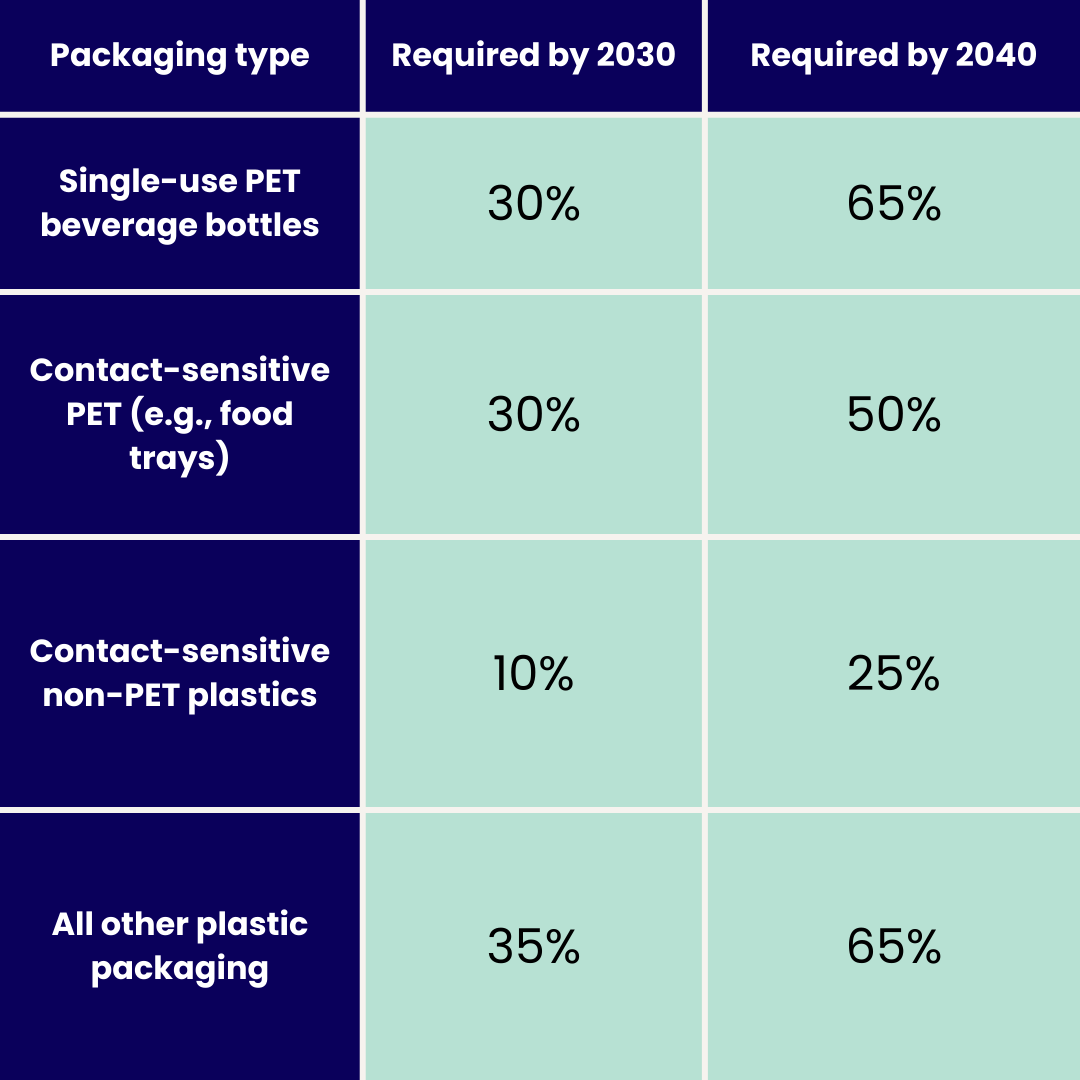
Securing post-consumer recycled (PCR) materials now is critical, as demand will outstrip supply in the years leading to 2030.
- Reuse targets: Mandatory for transport and beverage packaging (40% and 10% respectively by 2030), with e-commerce sellers required to offer reusable shipping options at checkout.
- Single-use plastics bans: Includes portion packaging for condiments and sauces in food service, fresh produce packaging under 1.5 kg, and on-site food containers in hospitality sectors.
The operational challenge behind the regulation
Companies must show where their packaging materials come from, what they contain, and whether they meet recyclability and recycled-content requirements in each market where products are sold. Many supply chains were never built to track this level of detail. Material composition now has to be documented across supplier networks, including sub-suppliers, and stored in a format regulators can review during audits or annual reporting.
At this scale, PPWR turns into a data and traceability problem inside the supply chain. The same type of traceability appears in other European initiatives, including Ecodesign rules and the upcoming Digital Product Passport (DPP), where products and packaging carry verified lifecycle information.
Costs are also tied to packaging performance. Under Extended Producer Responsibility systems, EPR fees change depending on how recyclable a packaging format is. Materials that are harder to recycle usually lead to higher fees, which raises operating costs.
Companies sometimes treat PPWR as a procurement task, but the work spreads across several teams. Packaging design choices affect compliance. Supplier selection affects documentation and recycled content. Reporting affects finance and regulatory teams. Once companies start mapping the data they need, supply chain, sustainability, and leadership teams usually end up working on the problem together.
How Marvin supports PPWR compliance
Marvin helps companies build the packaging traceability layer required to meet PPWR obligations.
By connecting supplier documentation, packaging composition data, certifications, and trade records, Marvin creates a structured digital record of packaging materials across product flows. This record shows where packaging originates, what materials are used, and how products move through the supply chain.
The same data structure also supports upcoming European requirements under the Ecodesign framework and the Digital Product Passport (DPP), where products and packaging must carry verified information about materials, origin, and lifecycle characteristics.
The platform also supports automation of Extended Producer Responsibility (EPR) reporting, collecting packaging data from suppliers and organizing it by material type, product, and destination market.
In addition, Marvin helps companies manage supplier certifications and compliance documentation, simulate supply-chain scenarios for recyclability and regulatory thresholds, and integrate packaging data into broader trade operations.
By combining packaging traceability, compliance automation, and trade intelligence, Marvin helps companies prepare for PPWR while improving sourcing decisions and reducing landed costs across their supply chains.

Our Latest Resources

In food processing, raw material integrity is the foundation of brand trust. SL Alimentos, a Brazilian processor of oats, grains, and agricultural ingredients, needed an integrated supply chain intelligence system to meet strict global sustainability standards across its supplier base.
Throughout history, civilizational breakthroughs have coincided with shifts in how humanity indexes space, maps energy, and moves physical resources. As Fernand Braudel observed in The Mediterranean and the Mediterranean World in the Age of Philip II, geography remains the unyielding backdrop against which all human enterprise must measure itself.