

The latest from Marvin
Moving the Needle on EBITDA
Why AI Agents Are the New Architecture for Global Supply Chain Arbitrage
For decades, the holy grail of global supply chain management was the “Control Tower”, a centralized dashboard designed to give organizations a bird’s-eye view of their global logistics. Billions of dollars were poured into visibility tools that promised to map every truck, vessel, and shipping container in real time.
But as the macro environment has shifted from temporary shocks to continuous, structural disruption, driven by shifting geopolitical boundaries, climate anomalies, and looming regulatory deadlines, the traditional paradigm has hit a wall.
“Visibility without remediation is just a front-row seat to your own capital leakage.” - Ofer Judovits, Marvin CEO
Knowing that a shipment is blocked at a customs checkpoint or delayed by a climate disruption doesn’t protect your margins. It just tells a human manager when to start panicking. To protect EBITDA and survive the next decade of global trade, forward-looking enterprises are moving past passive tracking and adopting a new architecture: AI Agentic Supply Chain Orchestration.
History Doesn’t Repeat, But It Often Rhymes
Every major technological revolution follows a predictable path: we first use new technology to make the old way of doing things a bit faster, and then we redesign the system from the ground up around the new capability to unlock true financial returns.
The Electricity Shift
When factories first transitioned from steam engines to electricity, they didn’t change their floor plans. They simply replaced one giant steam engine with one giant electric motor to turn the same overhead shafts and belts. Productivity and margins barely budged. Real economic value was unlocked only decades later when engineers realized each machine could have its own small electric motor, a completely new architecture that gave birth to the assembly line and redefined industrial throughput forever.
The Software Shift
Similarly, the early days of enterprise software simply digitized paper ledgers into stationary “Systems of Record” (ERPs) to speed up accounting. The workflow didn’t change; the pen just moved faster.
Today, supply chain software is trapped in its “steam shaft” phase. We are using data pipelines simply to feed static dashboards, optimizing existing, fragmented architectures rather than redesigning them. AI Agents represent the transition to the assembly line: an army of autonomous, specialized micro-engines capable of restructuring workflows and capturing hidden margins in real time.
The Landscape: Three Insulated Layers and the LatAm Paradox
The friction in global trade isn’t caused by a lack of software. It is caused by data asymmetry across layers that bleeds cash. Global supply chains do not operate on a single digital plane. They are divided into three highly insulated layers that traditional software struggles to bridge simultaneously:
- The Physical Layer: Moving bulk material via trucks, ships, and trains across variable terrain.
- The Contractual/Financial Layer: Navigating legal purchase orders, hedging price risks, and managing working capital.
- The Regulatory/Compliance Layer: Verifying polygon land-use, origin certificates, and shifting customs mandates.
This friction creates a profound paradox for Latin America (LatAm), which currently sits at the absolute center of the global supply chain chess board. As the world’s primary engine for vital commodities, pulp, paper, bio-feedstocks, and agricultural essentials, LatAm holds the keys to the global energy and manufacturing transition.
On the downstream end, regional titans export millions of tons of material to highly digitized, hyper-regulated markets like Europe and North America. On the upstream end, however, the supply chain dissolves into thousands of fragmented, informal nodes. A rural wood cooperative or an independent smallholder farm does not use SAP or electronic data interchanges. They coordinate via WhatsApp, hand-signed receipts, and chaotic spreadsheets.
Historically, Western enterprises viewed this fragmented upstream layer as a risk or a compliance headache. Forward-looking LatAm operators see it as the single greatest commercial opportunity of the decade. If a company can bridge this data gap, it doesn’t just avoid regulatory penalties, it unlocks an aggressive competitive advantage. By using technology to seamlessly verify the compliance, carbon footprint, and land-legality of these fragmented origin points, LatAm companies can bypass traditional trade barriers and command a massive green premium in international markets.
Instead of fighting on low-margin commoditization, automated multi-tier transparency allows regional anchors to break into high-barrier, premium destinations like Western Europe and strict ESG-mandated supply lines in North America. The goal is no longer just defending existing market share; it is about leveraging bulletproof, machine-verified origin data to capture high-margin global trade while keeping operational overhead near zero.
Introducing Marvin Agent: Your Dedicated Supply Chain Analyst
This is precisely the gap that Marvin’s latest native capability is built to close. We are announcing the availability of Marvin Agent, a conversational AI layer built directly into the platform and available today for all Marvin partners.
Marvin Agent works the way your best analyst would: it already knows your company, your suppliers, your trade flows, and your risk exposure. Instead of navigating dashboards or guessing where information lives inside the platform, your compliance manager, supply chain director, or logistics team can simply ask, in plain language and get answers. The intelligence is not behind a menu, it meets you where you are.
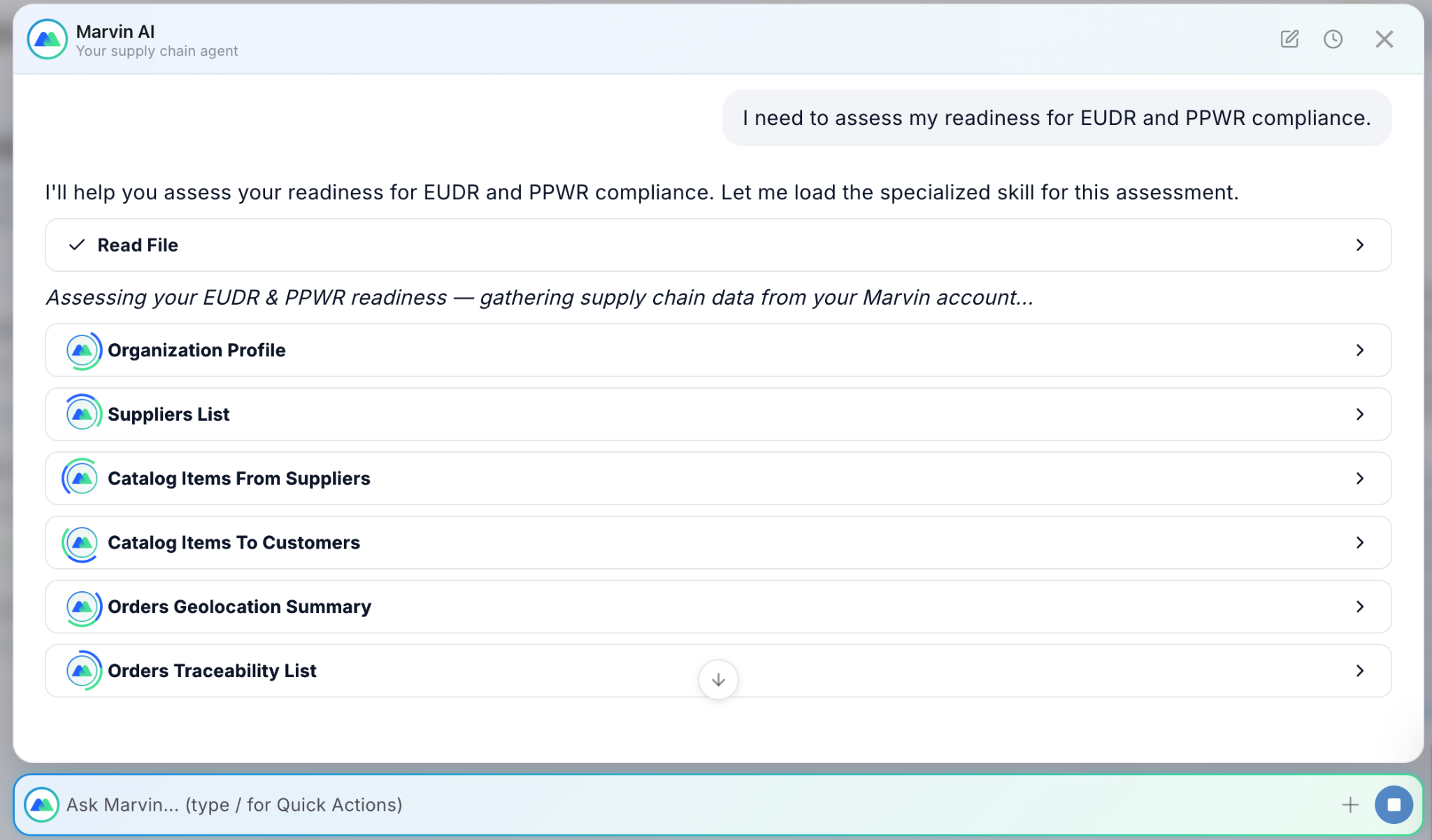
The scope is deliberately broad because supply chain decisions are never one-dimensional. Marvin Agent can be queried from a compliance angle, a logistics angle, a financial angle, a competitive angle, and more. It surfaces environmental risk scores, calculates optimal freight routes, compares supplier performance across time periods, and benchmarks your position within your own industry. The same interface that helps you avoid a regulatory penalty can, in the next query, tell you which supplier is most competitive on cash terms.
“We’re automating a very smart analyst who knows your company and knows exactly where to find the best information to compare.” - Aviv Gabbay, Marvin CTO
This is a rearchitecting of how supply chain intelligence reaches decision-makers, removing the latency between data and action, and replacing it with cognitive speed.
Use Case: From Compliance Exposure to Competitive Edge in Minutes
Consider a regional pulp exporter preparing to qualify for a new European buyer with strict EUDR and carbon-footprint requirements. Historically, this process would involve weeks of manual data gathering across procurement, compliance, and logistics teams.
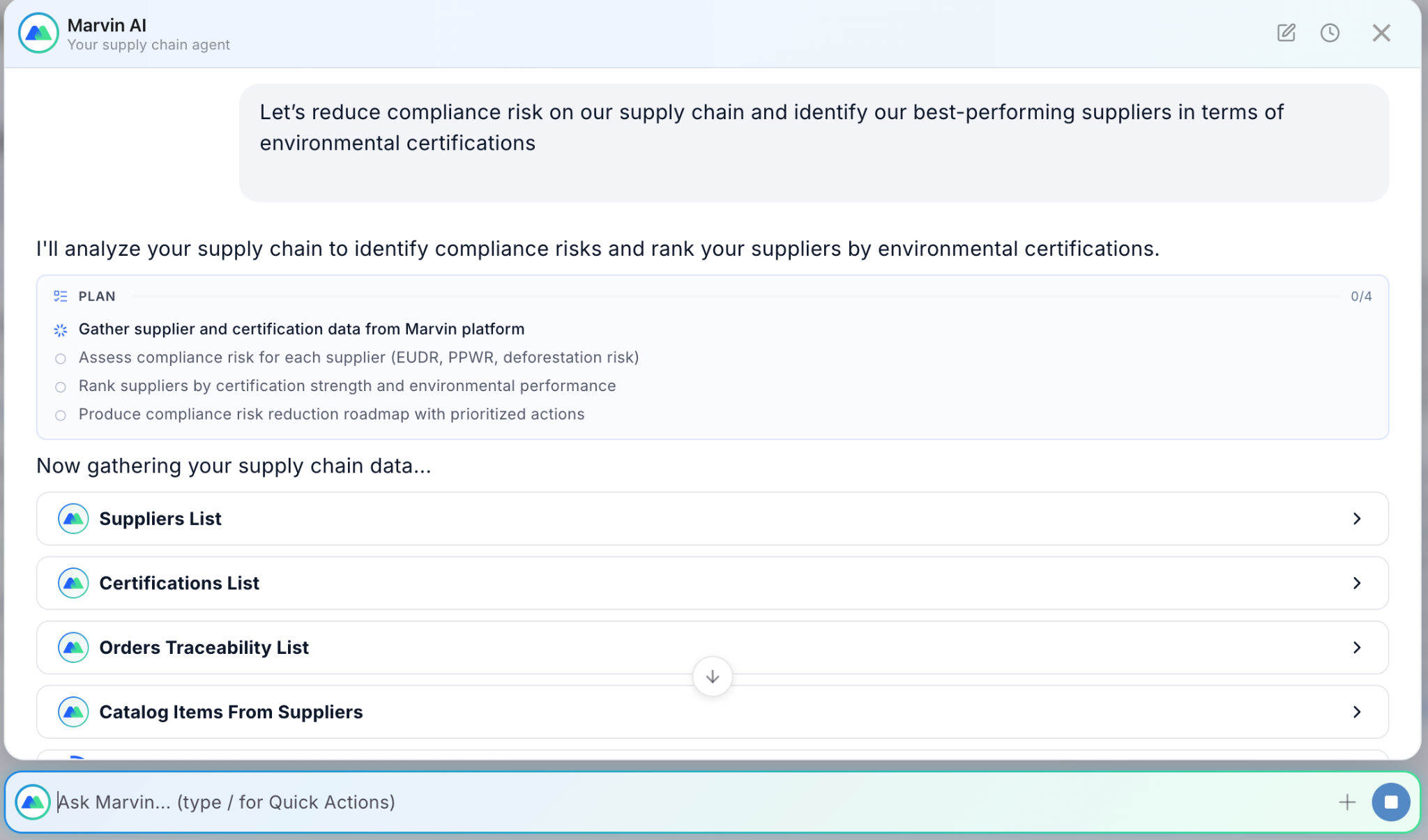
With Marvin Agent, the supply chain manager opens a single interface and asks: “Let’s reduce compliance risk on our supply chain and identify our best-performing suppliers in terms of environmental certifications.” Within seconds, Marvin Agent queries across supplier origin data, land-use polygon verification, and certification status, surfacing which upstream nodes are audit-ready and which require remediation. The manager follows up: “Now calculate the most cost-efficient logistics route to ship this cargo to Hamburg, and show me how our landed cost compares to our two closest competitors.” The same session that started as a compliance review ends as a margin and market-entry analysis, without switching platforms, hiring consultants, or waiting for a weekly report.
This is Marvin Agent in practice: a single expert that moves as fast as the questions.
A Self-Healing Trade Infrastructure
The market-shapers of global industry are demonstrating that the era of relying on fragmented point solutions, manual middle-office verification, and reactive dashboards is coming to a close.
Supply chains are no longer just physical pipelines, they are hyper-complex, interconnected networks of data and capital. The future belongs to the organizations that can process that data with absolute cognitive speed. By shifting to an architecture driven by AI Agents, enterprises are doing more than just protecting themselves against the next global disruption , they are building a self-healing, margin-optimized infrastructure capable of navigating the volatile terrain of tomorrow's global trade.

Our Latest Resources

In food processing, raw material integrity is the foundation of brand trust. SL Alimentos, a Brazilian processor of oats, grains, and agricultural ingredients, needed an integrated supply chain intelligence system to meet strict global sustainability standards across its supplier base.
Throughout history, civilizational breakthroughs have coincided with shifts in how humanity indexes space, maps energy, and moves physical resources. As Fernand Braudel observed in The Mediterranean and the Mediterranean World in the Age of Philip II, geography remains the unyielding backdrop against which all human enterprise must measure itself.